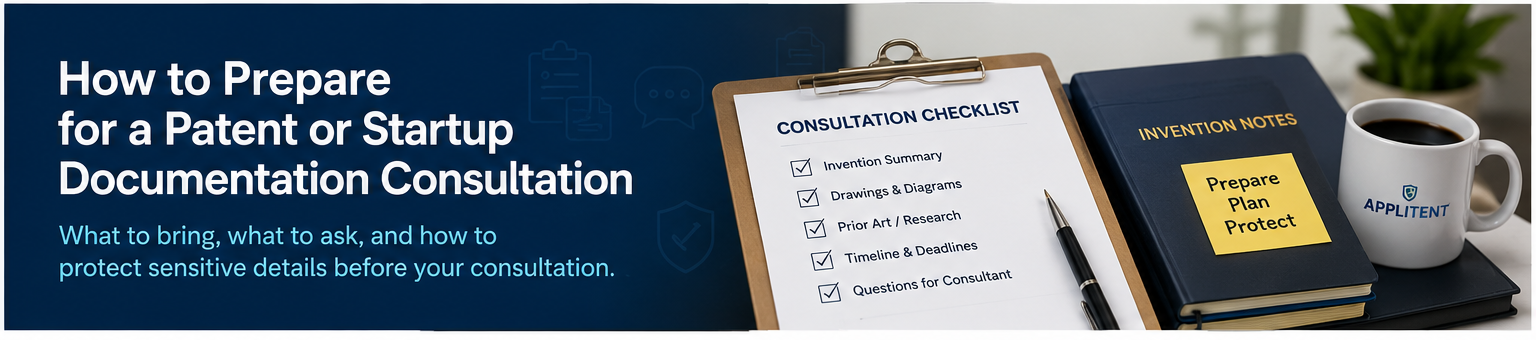
How to Prepare for a Patent or Startup Documentation Consultation
When people hear “consultation,” they often think they need to arrive with perfect documents, complete answers, and a polished story. In reality, the best first consultation is usually a structured readiness review. You want enough information to explain your goal, your stage, your timeline, and your main gaps.
The first move is to define the outcome you want from the conversation. Are you trying to figure out whether you need a stronger patent description first? Are you deciding between a PCT/WIPO path and later country-by-country work? Are you organizing a business plan or founder documentation for a broader application? Or are you exploring whether the commercial question is less about filing and more about a transfer or sale path?
If you begin the consultation with “I want to know what to do next in the next 30 to 90 days,” the conversation becomes much more useful than “I have a lot of files—can you look at everything?”
Start with a one-page case brief
A simple one-page case brief is usually the best starting document. Keep it plain and practical. At the top, state your goal in one sentence. Then add your current stage, target market or country if relevant, major deadlines, and the documents you already have.
For a patent matter, that may include a concept summary, inventor names, sketches, old filing data, or prior search notes. For a founder or business-plan matter, it may include a company summary, product overview, traction notes, team roles, and existing financial assumptions.
The point is not to impress anyone. The point is to reduce ambiguity.
What to prepare for patent-related consultations
For patent-related consultations, bring the materials that help someone understand the invention and the filing path. That does not mean you need a final patent application before the consultation. It means you should gather whatever version of the description, figures, claim outline, technical notes, or ownership information already exists so the consultation can focus on readiness rather than guesswork.
Useful materials may include:
- A short invention summary.
- Sketches, diagrams, screenshots, or photos.
- Inventor and applicant names.
- Any earlier filing dates or publication dates.
- Known deadlines or target countries.
- Any prior search notes or competing examples.
If international filing may matter
If your matter could involve an international patent route, add three more pieces of information to your case brief: any earlier filing date, the countries you think may matter, and whether you are still deciding where to seek protection.
Early consultations often need to clarify not just the invention, but also the priority timeline and the business logic behind country selection. This helps decide whether your next step is better aligned with a PCT/WIPO path, a national patent phase, or stronger preparation through a patent description workflow first.
If the goal is commercialization or sale
If your goal is more commercial than procedural, prepare differently. A consultation about possible patent transfer, licensing, or sale needs a short explanation of what exists today, who owns it, whether anything has been filed, and what business use case or buyer category you have in mind.
In practical terms, that means a consultation becomes much more productive when you bring ownership facts and a commercialization narrative, not just an idea.
Protect sensitive details before sharing too much
One of the most important consultation habits is knowing what not to disclose too early. If your invention is not yet protected and you are still deciding on a filing path, a first consultation should usually stay at the high-level summary stage.
A good consultation can still move forward using a problem statement, use case, basic architecture, timeline, and document-readiness summary without forcing you to disclose every technical detail too early.
Questions worth asking
It also helps to prepare better questions. Instead of asking only, “Can you handle this?” try questions like:
- What is missing from my current package?
- Do I need a stronger patent description before I think about PCT or national filing?
- Which dates matter first?
- What can stay high-level until NDA or private workflow?
- If my goal is commercialization, should I prepare for filing first or for a transfer discussion first?
Questions like these turn a vague intake into a practical roadmap.
What a good consultation should produce
A good consultation should end with a short memo to yourself. Write down the service path that seems most likely, the documents you still need, the questions that remain open, and the next milestone.
If the answer is “prepare the invention file before anything else,” that points naturally toward a stronger patent-description workflow. If the answer is “organize international filing facts,” the PCT/WIPO path becomes clearer. If the answer is “your commercial story is weak,” business-plan support may need to come before bigger filing or sale decisions.
Two simple examples
An inventor with a promising device concept and hand sketches may only need a clearer invention summary, inventor list, and drawing set before discussing a patent-description path.
A founder preparing a founder- or visa-adjacent application may need a sharper business model, market evidence, and milestone logic before the conversation about a business plan becomes useful.
Both people are “not ready” in the sense that their case is incomplete, but both are ready for a smart first consultation.
Final takeaway
Do not wait for perfection. Wait only long enough to organize the facts that reduce confusion. The first consultation is not an exam. It is a sorting step.
Request a free consultation if you want a clearer next step before choosing a service.