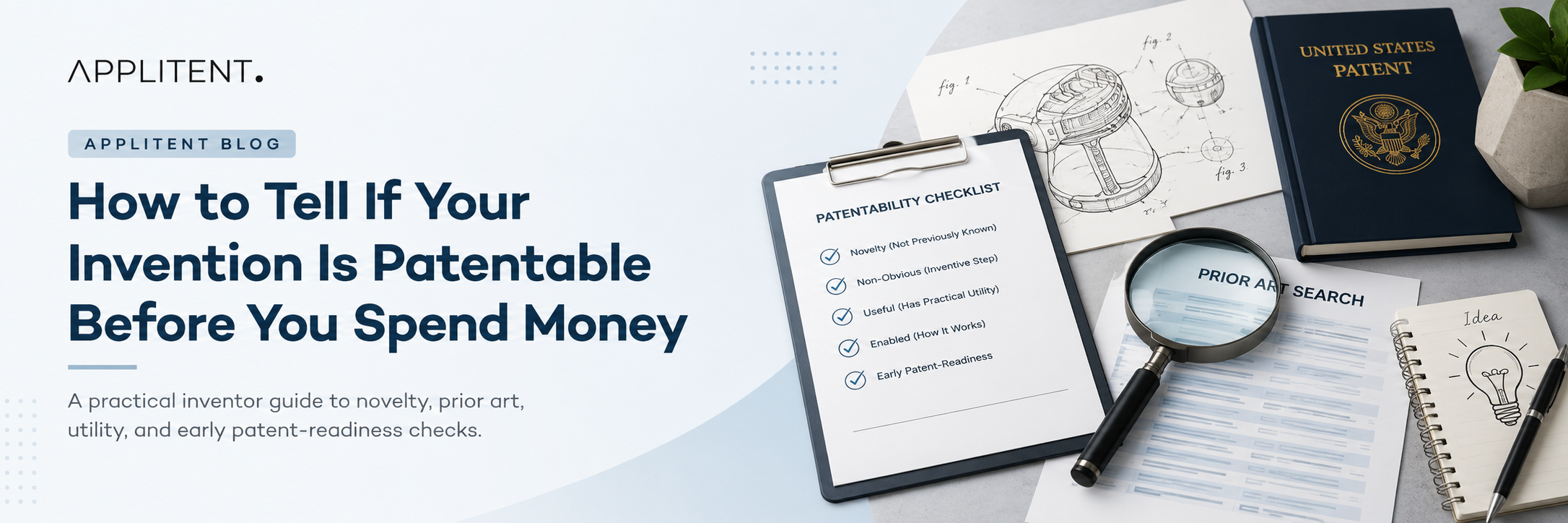
Many inventors reach the patent stage too early. They have an idea, a sketch, or a prototype, and the first question becomes: “Can I patent this?” That is a useful question, but it is not the first useful action. Before spending money on filing, drafting, or attorney review, you can do a practical early patentability check yourself.
This article is not legal advice and does not replace a patent attorney. It is a preparation guide. The goal is to help you organize your thinking before you request professional help, prepare a patent description, or decide whether your invention is ready for a more serious patent strategy.
1. Start with the three practical patentability questions
Most early invention reviews come down to three simple questions:
- Is it new? Has the same idea already been publicly disclosed, sold, published, patented, or used?
- Is it meaningfully different? Does your version add a non-obvious technical improvement, not just a small cosmetic change?
- Does it work in a useful way? Can you explain what it does, how it works, and why someone would use it?
If you cannot answer these clearly, do not panic. It means you need more documentation, search, and structure before spending heavily.
2. Write the invention in one plain paragraph
Before searching patents or paying for help, write one paragraph that explains the invention without marketing language. Use this format:
My invention is a [device/process/system/software method/material] that solves [specific problem] by using [main technical feature], so that [practical result].
If that sentence is hard to complete, the invention may still be too vague. A patent strategy depends on what is actually being protected. “An app for inventors” is not specific enough. “A document-generation workflow that detects missing invention disclosure fields before patent drafting” is much clearer.
3. Separate the problem, the solution, and the advantage
Inventors often mix these together. For patent-readiness, keep them separate:
- Problem: What is difficult, inefficient, risky, expensive, slow, unsafe, or inconvenient?
- Solution: What exactly does your invention do to solve it?
- Advantage: Why is this better than existing options?
This matters because novelty is not only about the final product. Sometimes the patentable part is the mechanism, sequence, architecture, material, method, control logic, or arrangement of components.
4. Do a first prior-art search before assuming the idea is new
Prior art includes more than patents. It can include product pages, research papers, videos, manuals, public presentations, app listings, marketplace pages, academic posters, GitHub repositories, and public use. Search broadly before you decide the idea is “new.”
Use phrases that describe the function, not only your chosen product name. For example, if your invention is a smart cap for medicine bottles, search:
- smart medicine cap reminder
- pill bottle dose tracking cap
- medication container sensor lid
- wireless pill bottle monitoring patent
Then repeat with synonyms. Inventors often miss prior art because they only search the words they personally use.
5. Look for the difference, not just similar products
Finding something similar does not always mean your invention is dead. The real question is: what is different, and is that difference meaningful?
Create a comparison table:
- Existing solution A: what it does
- Existing solution B: what it does
- Your invention: what it changes
- Technical improvement: why the change matters
If your difference is only branding, color, shape, price, or general convenience, it may be weak for utility-patent protection. If the difference changes how the system works, improves performance, reduces failure, saves energy, increases safety, or enables a new use, it may be worth deeper review.
6. Check whether you can explain how it works
A patent description usually needs enough detail for someone skilled in the field to understand the invention. You do not need perfect engineering drawings at the first step, but you should be able to explain:
- Main components
- How the parts connect
- Step-by-step operation
- Alternative versions
- Materials or software logic, if relevant
- What happens when the user interacts with it
- What problem each feature solves
If your explanation depends on “we will figure that out later,” the invention may need more development before filing.
7. Protect confidentiality before sharing
Public disclosure can create patent problems in many jurisdictions. Before pitching the invention, posting it online, sending it to manufacturers, or showing it publicly, keep records and use controlled disclosure.
At the early stage, share only high-level information unless the other party is covered by a proper confidentiality arrangement or is a qualified professional with confidentiality obligations. When in doubt, keep the technical details private until you have a filing or NDA strategy.
8. Make an invention-readiness folder
Before a consultation, collect:
- One-paragraph invention summary
- Problem/solution/advantage table
- Sketches, photos, diagrams, or prototype images
- Prior-art search notes
- List of public disclosures, if any
- Development timeline
- Inventor names and contributor roles
- Commercial goals: file, license, sell, raise funding, or build product
This turns a vague idea into a reviewable invention package.
9. When to ask for professional help
You should request help when you have a clear enough invention summary, a first prior-art search, and a reason to protect or commercialize the idea. Professional support can help you decide whether to prepare a patent description, run deeper prior-art review, plan PCT/WIPO timing, prepare national-phase documentation, or organize the invention for sale or licensing.
If you are unsure where to start, Applitent can help you organize the invention information before a deeper patent or commercialization step.
Useful next step: Request a free consultation or explore Patent Description support if you need help turning your idea into a structured invention document.