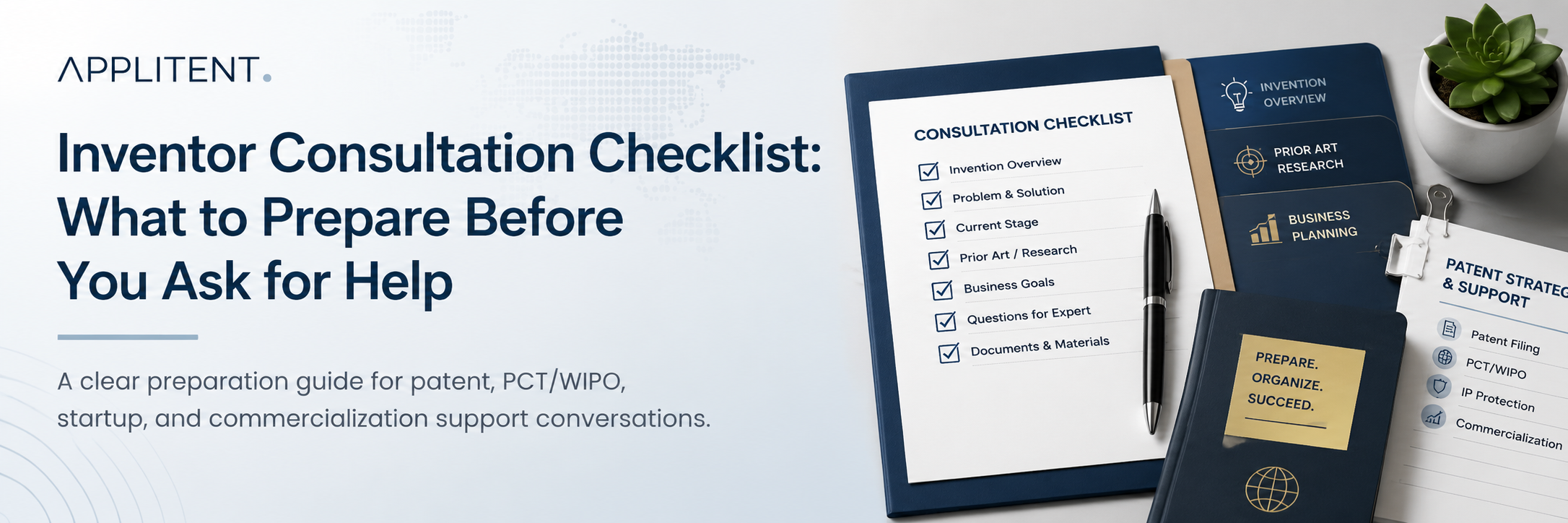
A good consultation does not start with perfect documents. It starts with clear thinking. Whether you need patent-description support, PCT/WIPO planning, national phase preparation, patent sale guidance, startup visa documents, or a business plan, the quality of the first conversation improves when your information is organized.
This checklist helps inventors prepare before asking for help, without oversharing sensitive details too early.
1. Prepare a short invention overview
Write a simple overview in 5–8 sentences:
- What is the invention?
- Who is it for?
- What problem does it solve?
- How does it solve the problem?
- What stage is it in?
- What kind of support do you need?
A clear overview lets the reviewer understand your situation quickly and decide what questions to ask next.
2. Explain the current stage honestly
Do not exaggerate. Say whether your invention is:
- Only an idea
- Sketched
- Partly designed
- Prototyped
- Tested with users
- Filed as a patent application
- Already published or sold
- Ready for licensing or sale discussion
The right strategy depends heavily on the current stage.
3. Collect your problem and solution notes
Every invention consultation should include a problem/solution explanation. Use this simple structure:
- Problem: What is broken, slow, expensive, unsafe, unreliable, or inconvenient?
- Existing solutions: What do people use now?
- Your solution: What changes?
- Advantage: Why is your approach better?
This helps connect invention protection with market usefulness.
4. Bring sketches, images, diagrams, or screenshots
You do not need perfect drawings at the first step. Even rough sketches can help. If the invention is physical, include photos or diagrams. If it is software, include workflow diagrams, screen concepts, or system logic. If it is a process, show the steps.
Visuals reduce confusion and help the reviewer understand what is actually new.
5. Prepare your prior-art and competitor notes
Before the consultation, search for similar products, patents, videos, articles, and companies. You do not need a professional search yet. Just collect what you found and explain why you think your invention is different.
Useful notes include:
- Names of similar products
- Links to existing solutions
- Patent or publication links, if found
- What each existing option lacks
- What your invention improves
6. List public disclosures
Write down whether you have already shared the invention publicly. Include:
- Online posts
- Videos
- Pitch decks
- Trade show presentations
- Crowdfunding pages
- Factory/manufacturer emails
- Sales offers
- Academic or conference publications
This helps the support team understand urgency and risk.
7. Decide your main goal
Inventors may want different outcomes. Choose your primary goal:
- Prepare a patent description
- Understand PCT/WIPO options
- Prepare for national phase entry
- Sell or license the patent/invention
- Build a business plan
- Prepare startup visa or talent visa documentation
- Improve personal branding or professional evidence
- Organize documents before speaking with a lawyer or partner
The clearer the goal, the more useful the consultation.
8. Prepare questions before the call or message
Good questions produce better answers. Examples:
- Is my invention information organized enough for patent-description work?
- What is missing before PCT/WIPO planning?
- Should I focus on patent filing, prototype testing, or commercialization first?
- What can I safely share at this stage?
- What documents are needed for business-plan support?
- What should I prepare before discussing patent sale or licensing?
9. Keep sensitive details high-level at first
In the first message, you can describe the problem, general solution, industry, stage, and goal without revealing the secret technical core. If deeper review is needed, ask about confidentiality, NDA, dashboard upload, or private document process.
This protects the invention while still allowing a useful first response.
10. What to expect after submitting a consultation request
After you submit a request, the team reviews your message and decides which service path may fit. You may be asked for clarification, documents, or a more detailed explanation. Submitting the form does not create a paid order. It starts the evaluation conversation.
Useful next step: Start with Applitent’s free consultation. If you already know the service you need, review Patent Description, PCT/WIPO Support, National Phase Patent Support, Patent Sale, or Business Plan.