Inventors often ask the same question too late: should I build the prototype first or file a patent first? The honest answer is: it depends on the invention, the disclosure risk, the budget, and how much technical detail is already clear.
The better question is not “prototype or patent?” It is: “What order reduces risk while moving the invention forward?” This guide gives inventors a practical sequence for balancing testing, documentation, confidentiality, and filing strategy.
1. Why the order matters
If you prototype too early without documentation, you may spend money building the wrong thing. If you publicly show the prototype too early, you may create disclosure risk. If you file too early, the patent description may be weak because the invention is not developed enough. If you wait too long, someone else may publish, file, or commercialize something similar.
The goal is to avoid both extremes: filing a vague idea and overbuilding an unprotected invention.
2. Start with a written invention map
Before prototype or patent, create an invention map:
- Problem
- Target user
- Current alternatives
- Main technical solution
- Key features
- Possible variations
- What needs testing
- What should remain confidential
This gives you a working foundation. It also helps decide whether the prototype is needed to prove function or whether the invention is already explainable enough for a patent-description discussion.
3. When prototyping first makes sense
Prototype first when the invention’s value depends on proving that it works. This is common with mechanical devices, physical products, materials, hardware, medical-adjacent devices, manufacturing methods, and usability-focused inventions.
Prototype first can help when you need to answer:
- Does the mechanism actually work?
- Which material or size is practical?
- What fails under real conditions?
- Does the user understand it?
- Which feature is the true invention?
But keep the prototype private. Use controlled testing and record results.
4. When patent preparation first makes sense
Patent preparation first makes sense when you already understand the invention clearly, when the disclosure risk is high, or when you need to speak with manufacturers, investors, buyers, or partners soon.
You may not need a finished prototype if you can describe the invention clearly enough. Many patent strategies are based on a complete technical disclosure, not a perfect market-ready product.
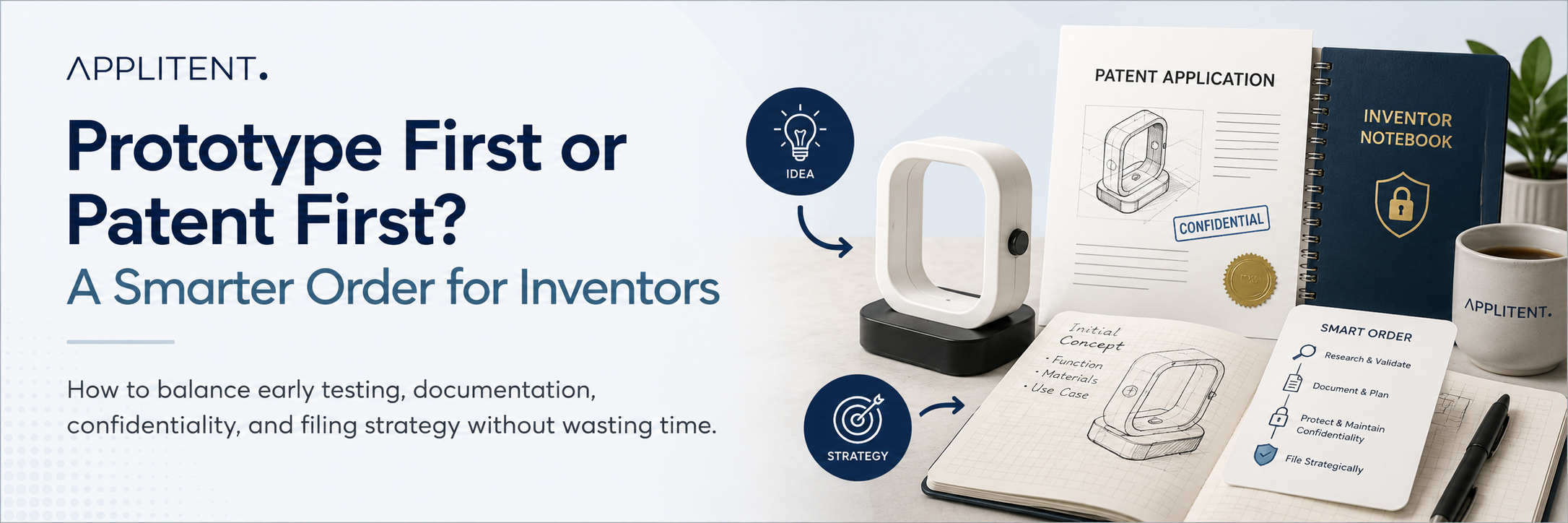
5. The smarter order for many inventors
A practical sequence is:
- Document the invention privately.
- Run a basic prior-art and market search.
- Identify what must be tested.
- Build a private rough prototype or proof of concept if needed.
- Update the invention description based on testing.
- Keep disclosure controlled.
- Discuss patent-description or filing strategy.
- Then prepare public pitching, licensing, sale, or fundraising material.
This order helps you avoid wasting money while preserving your options.
6. Do not confuse prototype value with patent value
A prototype shows that something can work. A patent strategy focuses on what is new, useful, and protectable. Sometimes the prototype is impressive but the patentable difference is small. Sometimes the prototype is simple but the technical method behind it is valuable.
Ask: what exactly should be protected? The product, the mechanism, the process, the control logic, the material, the arrangement, the use case, or the system architecture?
7. Keep testing confidential
If you test with users, contractors, factories, or designers, think carefully about confidentiality. Use limited disclosure, NDAs where appropriate, and a disclosure log.
For early user feedback, you may be able to test the problem and value proposition without revealing the technical solution. That keeps the invention safer while still gathering useful information.
8. Prepare for commercialization while protecting the core
Inventors who want to sell, license, or raise funding need more than a prototype. They need:
- A clear invention summary
- Evidence of problem and demand
- Prototype or testing notes
- Patent/readiness strategy
- Non-confidential pitch version
- Business model or licensing direction
This is where patent documentation, patent sale planning, business plan support, and personal branding can connect.
9. Warning signs that you are moving in the wrong order
- You are posting prototype videos before understanding filing risk.
- You are spending heavily on design before knowing the technical core.
- You are asking for patent filing with only a vague idea.
- You are sharing full drawings with manufacturers without records.
- You do not know whether similar products already exist.
- You cannot explain what makes your invention different.
10. A practical decision rule
If the invention is technically clear and disclosure risk is high, prepare the patent documentation first. If the invention is still uncertain and function must be proven, prototype privately first. If both are true, do a small private prototype and a structured invention description in parallel.
Useful next step: Applitent can help you organize invention details, patent-description materials, business-plan logic, or patent sale preparation. Start with a free consultation, or explore Patent Sale support and Business Plan support.